Feasibility, quotation, and project set-up.


Swindon Silicon’s enhanced analogue and mixed-signal custom integrated circuits, designed to our customers’ demanding requirements, deliver a product with a distinct and unique technical and commercial advantage.
Our full-turnkey service starts from initial specifications through to the supply of volume-tested and calibrated ASICs, including analogue and mixed-signal ASIC design, production test development, packaging, component production, logistics and supply chain management. We also provide full evaluation, characterisation, industrial and automotive qualification (AEC Q100) and full failure analysis in accordance with defined industry standards such as TS 16949.
This full-turnkey service enables our customers to be able to focus on their core competencies whilst we design, manufacture, production test, and supply their ASIC solution anywhere in the world.
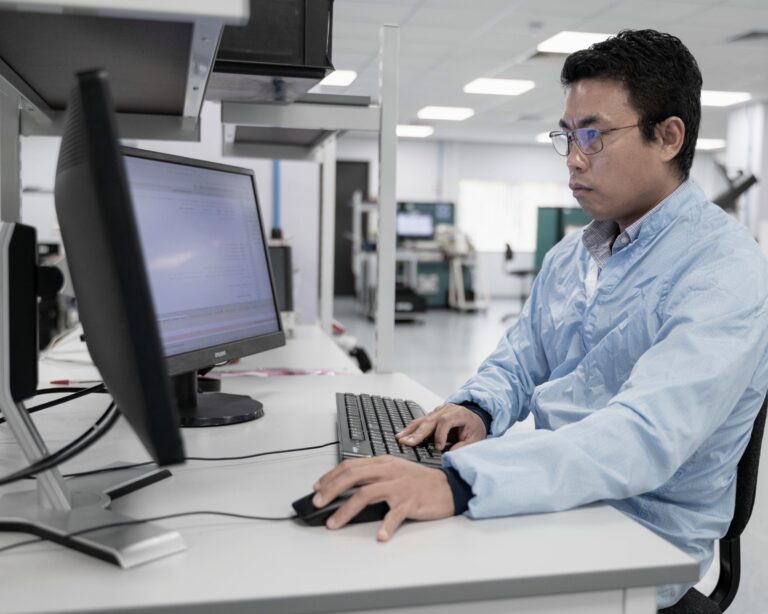

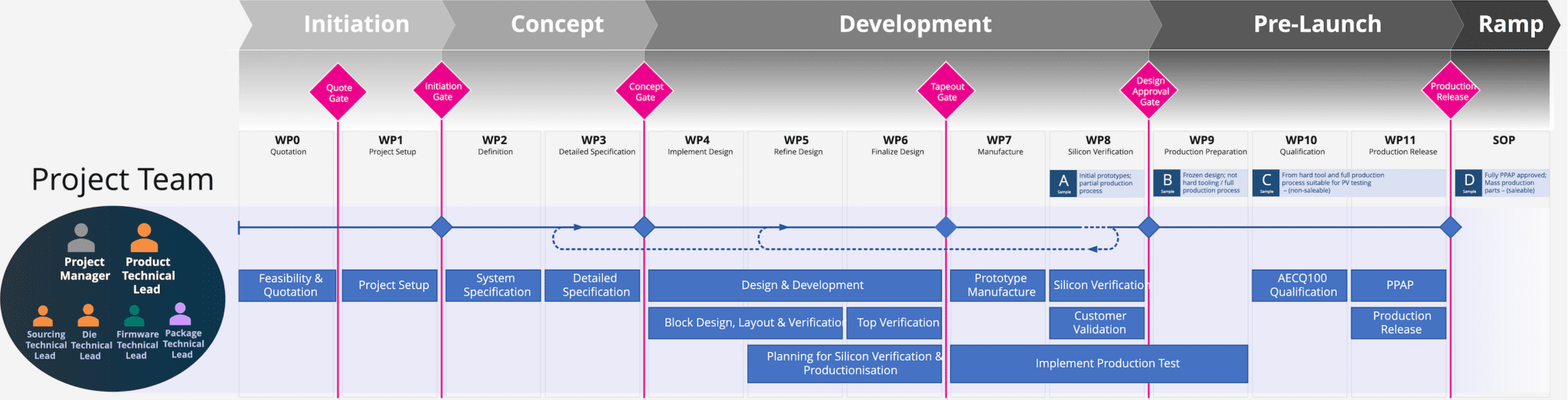
The Swindon Silicon team consists of Consultant, Design, Layout, Verification and Test engineers working together in a structured and controlled process that delivers the optimum outcome for our customers. This is split into various phases, which themselves are further divided into Work packages.
As a fabless, full-turnkey ASIC supplier, we handle everything in-house except wafer processing and packaging. This provides our customers with a proven and trusted supplier that takes full responsibility for every phase of the development project, including the supply of 100% production-tested ASICs.
Our ASIC design flow moves through four phases, each broken into structured work packages:
Feasibility, quotation, and project set-up.
Requirements capture and ASIC specification.
Mixed-signal design, layout, and engineering samples/prototyping.
Qualification, production release, and full-turnkey supply.
We will conduct an initial meeting and discussions with the customer to determine the following;
Once this is completed to both parties’ satisfaction, we will produce a Technical Report, with no obligation. This report will describe the findings from the above from a technical viewpoint. This ensures we fully understand the technical requirements and commercial objectives of the proposed ASIC development.
Once the customer is satisfied with the content of the report, we will supply a quotation that will cover all aspects of the project, starting with the ASIC specification and ending with the production release of the ASIC.
The quotation will cover all work packages, project timings and milestones and associated payment milestones.
The quotation will include the following;
The customer can fully budget for the entire project from this one detailed document, as there are no hidden charges or design iterations.
A full Development Agreement will be entered into upon acceptance of the quotation. Our internal legal teams assist in drafting the document. This is highly useful to both parties, as it helps expedite a signed contract.
Project set up is the initial start of the project and will consist of the following:
The concept phase is the capture of all the customer’s unique requirements and the production of an ASIC specification. The ASIC specification is critical in defining the detailed requirements of the ASIC, including max – min values for all key parameters. This document is key to the on-time and on-budget project, as any ambiguity within the specification can lead to costly redesign work and project delays.
The concept phase consists of the following:
Our team of ASIC designers, utilising our own IP library from production-proven former designs and supplemented by the digital block IP libraries of its foundry partners, form the base for a predictable development plan.
In all ASICs where market leadership is the aim, custom circuits will be required to provide that competitive edge. We have deep engineering talent to meet all aspects of the design in-house. This ensures the customer meets critical time-to-market while benefiting from a unique solution and product.
The ASIC development phase includes:
Our layout engineers translate the verified mixed-signal design into physical silicon, working within the foundry’s process design rules to optimise for yield, device matching, and noise immunity, requirements that are more demanding for analogue and mixed-signal circuits than for a purely digital layout.
Once the design is taped out, we produce engineering samples via Multi Layer Mask (MLM) or Multi Project Wafer (MPW) routes depending on volume and timeline, for wafer probe and ATE test verification ahead of customer evaluation.
Pre-launch is another key aspect of the ASIC design flow, and it is within this phase that the ASIC moves from being an engineering sample / prototype / pre-production device into a fully qualified production-released ASIC.
The process from design development to volume production: our customer and we must fully validate the ASIC performance. The customer must approve the ASIC and the qualification results before production releases the ASIC.
Swindon Silicon has been production releasing our ASICs for volume production for nearly 50 years, and it is a key competence in our design flow. We production test 100% of the ASICs that we deliver, either at wafer probe, ATE or both, at our test facilities in the UK and Malaysia.
Our objective is to create an efficient, high-yielding manufacturing solution that fulfils each customer’s unique requirements and meets stringent market demands.
Before an ASIC can move to volume production, it must pass full qualification against industry and customer standards, validating performance across the specified voltage, temperature, and reliability range, and confirming the device is ready for sign-off.
Production release isn’t the end of the story – ongoing test, quality management and lifecycle support keep an ASIC performing reliably for years after it ships. Read more in our article, ASIC test, quality and lifecycle: what happens after design.
Swindon Silicon Systems is a global leader in the design and supply of automotive and industrial mixed-signal ASIC solutions for today’s increasingly connected world.
Speak to us about your ASIC project in an informal, no-obligation discussion.