In a world of increasing electrification and intelligent sensing, mixed-signal integrated circuits (ICs) have become indispensable. From tyre pressure monitoring systems and battery management in electric vehicles to navigation systems in aerospace, mixed-signal ICs are working quietly at the heart of some of the most demanding applications on the planet. Yet despite their ubiquity, many engineers and product managers remain unclear about what mixed-signal IC design actually involves and why it matters for their applications.
This article explores what mixed-signal design is, why it has become a critical capability in modern electronics, and how it can unlock competitive advantages in your product.
What is a mixed-signal integrated circuit?
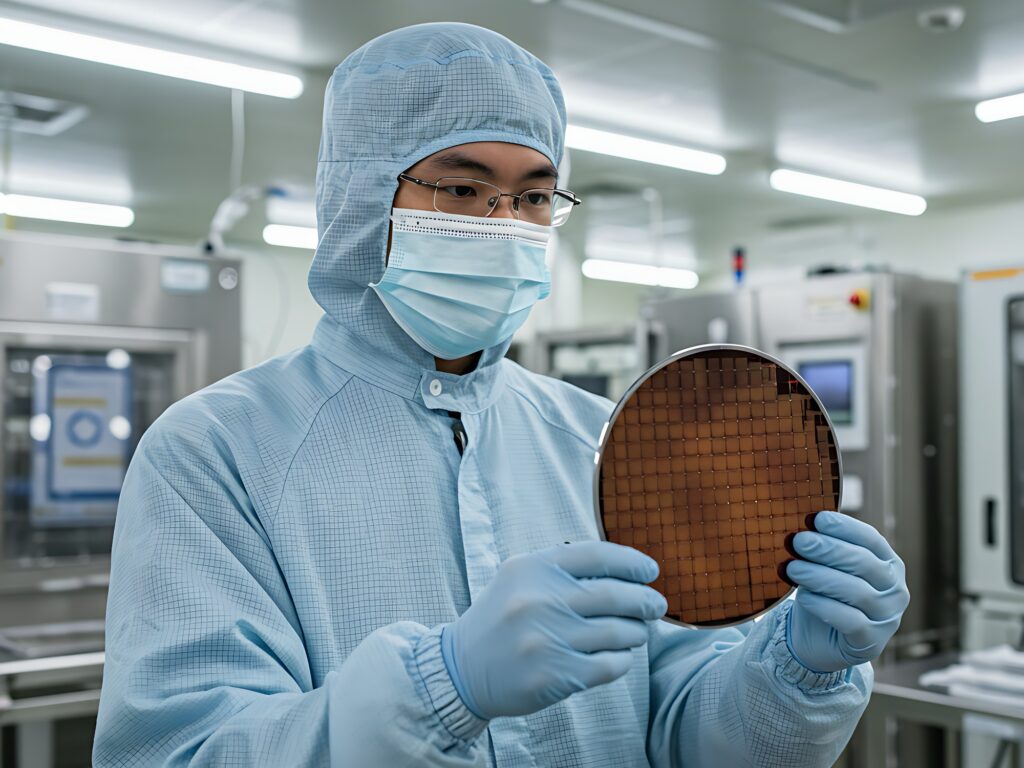
A mixed-signal integrated circuit (ASIC) is one that processes both analogue and digital signals on the same die. The key distinction is that analogue and digital circuits process information in different ways. Analogue circuitry preserves and manipulates continuously varying signals, while digital circuitry represents and processes information using logic states. A mixed-signal IC combines both approaches on the same die.
In practical terms, this means a mixed-signal IC can:
- Receive a real-world analogue signal (such as temperature, pressure, or acceleration) from a sensor
- Condition and amplify that signal using on-die analogue circuits
- Convert it to digital form using an analogue-to-digital converter (ADC)
- Process the digital data using embedded digital logic or microcontrollers
- Generate control signals or communicate with other systems via digital interfaces
The result is a single piece of silicon that handles the complete signal chain from raw sensor input to processed digital output. This is more elegant than connecting separate analogue and digital components.
Why mixed-signal IC design matters
Mixed-signal IC design has become strategically important for several reasons.
System integration and miniaturisation
When you integrate analogue signal conditioning and digital processing onto a single die, you eliminate multiple separate components. This delivers dramatic reductions in printed circuit board (PCB) area, power consumption, and overall system weight. For automotive and aerospace applications, where every millimetre and milliwatt counts, this integration is transformative. A sensor interface IC, for example, can replace a board-level design spanning tens of square centimetres with a few millimetre-square die.
Enhanced reliability and performance
On-die integration minimises signal degradation. Analogue signal paths that would otherwise cross the PCB and pick up noise are now internal to the silicon. Temperature variations, power supply ripple, and electromagnetic interference (EMI) are all better managed within a carefully engineered mixed-signal design. The result is more stable, more repeatable performance: a critical requirement in safety-critical systems.
Cost efficiency and supply security
A custom IC designed specifically for your application can replace a design that uses off-the-shelf analogue and digital components. This offers several commercial advantages: a lower bill of materials (BOM), reduced assembly complexity, a smaller inventory footprint, and, crucially, the reduction of obsolescence risk. For mission-critical, long-lifecycle products, a custom IC lets you plan supply security proactively over 15-20+ years, rather than reacting to a supplier’s end-of-life announcement. While obsolescence remains a possibility, a custom IC partner can work with you to mitigate the impact and ensure sustained supply.
Intellectual property protection
Your product’s unique signal processing algorithms and system behaviour can be embedded directly into silicon. This makes reverse-engineering far more difficult than if the same logic exists in firmware or discrete components. For proprietary systems, this is a significant competitive advantage.
Where mixed-signal IC design is applied
Mixed-signal design is not a niche. It underpins critical systems across multiple industries.
Automotive systems
Mixed-signal design is common in the automotive industry. Tire pressure monitoring (TPMS), engine control, battery management in electric vehicles, advanced driver assistance systems (ADAS), and brake and traction control all rely on mixed-signal ICs to acquire and process sensor data in real time. See our blog on automotive ASICs for more detail on how they can add value.
Industrial automation and sensing
Position sensors, pressure transducers, temperature monitors, and proximity detectors in factory automation systems all benefit from on-die signal conditioning and digital logic. Mixed-signal design enables these sensors to be smarter, faster, and more reliable than discrete implementations.
Aerospace and defence
Navigation systems, inertial measurement units, and flight control sensors operate in extreme environments where reliability and longevity are non-negotiable. Mixed-signal ICs tailored for aerospace applications can deliver the performance margins and supply assurance that these mission-critical systems demand.

The key disciplines in mixed-signal IC design
Designing mixed-signal ICs requires expertise spanning multiple engineering domains:
Analogue circuit design
This is the art of designing amplifiers, filters, precision reference circuits, and signal-conditioning blocks that operate reliably across manufacturing variation, temperature ranges, and power-supply tolerances. Analogue design requires a deep understanding of device physics, noise sources, and system-level tradeoffs.
Digital logic design and embedded systems
Digital blocks within the IC handle data processing, interface protocols (SPI, I2C, CAN, and so on), and system control logic. This requires proficiency in hardware description languages (HDL), functional verification, and embedded firmware integration.
Physical design and layout
Certain decisions can make or break a mixed-signal design: how analogue and digital circuits are floor-planned on the silicon, where power and ground are routed, and how components are physically positioned to minimise crosstalk and noise coupling. A poorly laid-out mixed-signal IC may simulate perfectly, but fail in the real world.
Verification and characterisation
Mixed-signal verification spans simulation (with both analogue and digital simulators), silicon measurements across process corners and temperature ranges, and long-term reliability testing. This is essential because the interaction between analogue and digital domains can create unexpected failure modes.
How mixed-signal IC design works
The mixed-signal IC design flow typically follows a structured sequence, though the exact process varies by company and application complexity. At its core, the process moves from requirements and architecture through design, verification, physical implementation, manufacturing, and testing.
Capturing requirements and defining system architecture are critical. The right questions early on shape everything downstream: input signal ranges, required resolution and sampling rate, temperature and supply voltage tolerances, and interface protocols. This is where deep expertise prevents costly mistakes later.
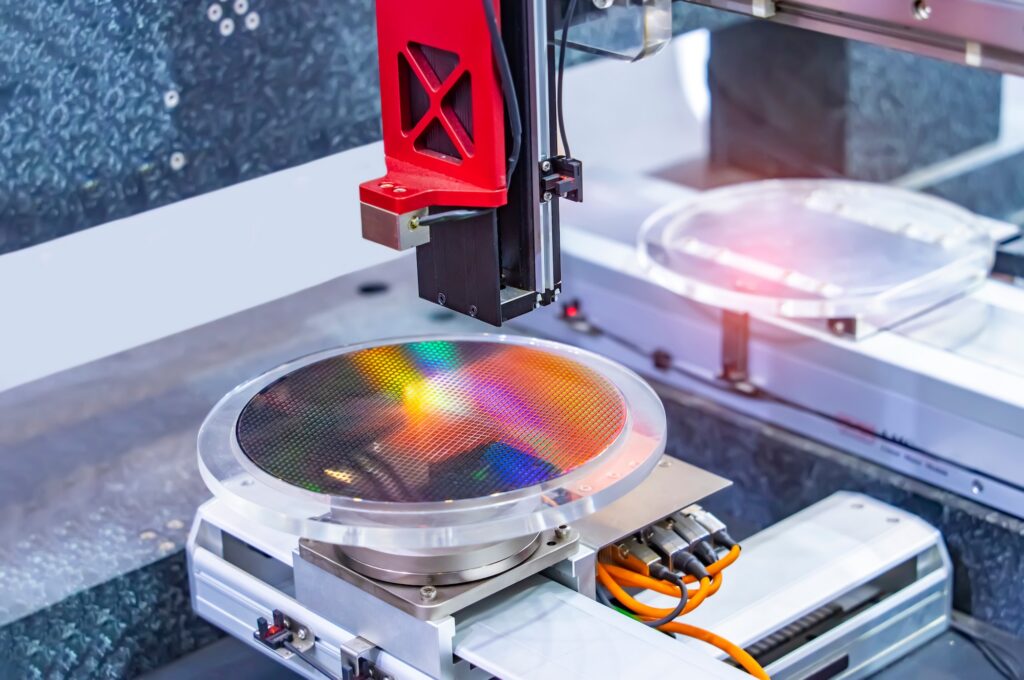
Once the architecture is defined, analogue and digital sub-blocks are designed in parallel, then integrated, simulated, and refined. Physical implementation – placing transistors, routing wires, and optimising layout – requires deep expertise and often multiple iterations to meet timing, noise, and power constraints.
The design then progresses to silicon fabrication, and after manufacturing, extensive testing and characterisation confirm that the real silicon performs as designed. For mission-critical applications, this includes burn-in testing, stress testing, and qualification across the full operating envelope.
These complexities are why mixed-signal IC design is a specialist discipline, but also why the competitive advantages of getting it right are so substantial. For a deeper dive into the design process, see our guide to mixed-signal ASIC design.
When should you choose a mixed-signal IC design approach?
Mixed-signal IC design is worth considering when:
- Your product demands very tight integration, such as where PCB area, power consumption, or thermal management are critical constraints
- You require long-term supply security or protection against component obsolescence
- Your market volumes support a custom IC business case (typically from 1-10K units per year and upward)
- You have proprietary algorithms or system behaviour worth protecting
- The application is mission-critical or operates in harsh environments, where reliability margins matter
Importantly, mixed-signal IC design is no longer the preserve of high-volume consumer electronics. Mature process nodes (0.35 µm, 0.18 µm) offer cost-effective pathways for automotive, industrial, and aerospace applications. A feasibility discussion with an experienced mixed-signal design partner can help you evaluate whether a custom IC approach is right for your product.
Mixed-signal IC design as a strategic capability
Mixed-signal IC design is far more than a technical feature. It is a strategic differentiator. The ability to integrate analogue sensing and digital processing onto a single die, tailored precisely to your application’s demands, unlocks product innovation that is difficult for competitors to replicate. It delivers lasting advantages in cost, performance, reliability, and supply security.
Whether you are developing next-generation automotive sensors, smart industrial controls, or aerospace systems, the competitive advantage mixed-signal design can bring to your product often outweighs the engineering investment.
If you would like to explore whether a custom mixed-signal IC could benefit your application, you can contact Swindon Silicon Systems for a feasibility discussion. With over 40 years of experience in mixed-signal design and over 1 billion ICs shipped, we can help you turn your concept into reality.