
Keeping HGV braking systems connected: ASIC-enabled CAN communication in heavy vehicle applications

Reliable communication between braking systems is fundamental in heavy goods vehicle (HGV) applications, where electrical noise, wiring faults and demanding operating conditions place considerable pressure on electronic systems.
For a heavy-vehicle brake system and air suspension solution manufacturer, introducing ISO 11992-compliant Controller Area Network (CAN) communication into its brake control products exposed a gap in standard semiconductor capabilities, leading the company to turn to us for a bespoke ASIC design solution.
Client
Heavy-vehicle brake system and air suspension solution manufacturer
Sector
Commercial vehicle (HGV) braking systems
Challenge
Standard ICs couldn’t meet the combined electronic performance, integration and production-continuity needs for ISO 11992-compliant CAN communication in a commercial vehicle platform
Solution
A bespoke mixed-signal ASIC, developed by us via our full turnkey (FTK) approach
Result
Deployed across multiple HGV brake controller programmes; stable field performance over many years.
The challenge
Reliable communication between braking systems is fundamental in heavy goods vehicle (HGV) applications, where electrical noise, wiring faults and demanding operating conditions place considerable pressure on electronic systems. For a heavy-vehicle brake system and air suspension solution manufacturer, introducing ISO 11992-compliant controller area network (CAN) communication into its brake control products exposed a gap in standard semiconductor capabilities, leading the company to turn to us for a bespoke ASIC design solution.

CAN is a vehicle communication protocol widely used to allow electronic control units within automotive systems to exchange data reliably. In HGVs, ISO 11992 defines communication between towing and towed vehicles, including braking and running gear systems.
At the time, commercially available integrated circuits (ICs) could not satisfy the combination of electronic performance, integration capability and production continuity needed for a commercial vehicle platform. The manufacturer therefore partnered with us to develop an ASIC designed specifically for heavy-vehicle brake controller systems.
The solution
ISO 11992 governs communication between truck and trailer systems in HGVs, particularly within braking applications where coordinated operation is essential. While CAN itself is a well-established protocol, implementing it successfully within a commercial vehicle braking platform involves far more than basic compliance.
The application had to operate reliably under fluctuating supply voltages, electrical interference and potential wiring faults commonly found in HGV systems. Stable behaviour over extended service periods was equally important, particularly given the expected lifespan of commercial vehicle platforms and the need for repeatable production over many years.
To address this, we developed a mixed-signal ASIC implementing the CAN interface directly into silicon. This reduced reliance on external interface components and enabled tighter integration within the wider brake controller architecture.
The ASIC incorporated a revised physical CAN interface intended specifically for HGV electrical systems, including operation against proportions of vehicle battery voltage and improved tolerance to wiring-related faults. Integrating this functionality directly into the device also helped simplify surrounding electronics and reduce overall board-level complexity.
“Commercial vehicle electronics are expected to stay in service for a very long time, often in fairly unforgiving electrical conditions,” said Ross Turnbull, our Director of Business Development. “You are not only looking at performance on day one, but how consistently that device behaves over years of production and operation.”
Alongside the technical design work, manufacturability and production stability remained central considerations throughout development. In commercial vehicle applications, electronic platforms are often expected to remain available for many years, with minimal variation between production generations. The ASIC therefore needed to support consistent manufacturing behaviour as well as dependable operation in the field.
“One of the biggest pressures in automotive electronics is not just performance at launch but keeping proven systems in production when parts start to disappear from the market,” said Ross Turnbull. “If you can design in continuity from the start, you end up with a much more resilient supply chain for the suppliers and a lot less disruption further down the line.“
From ASIC development to deployment
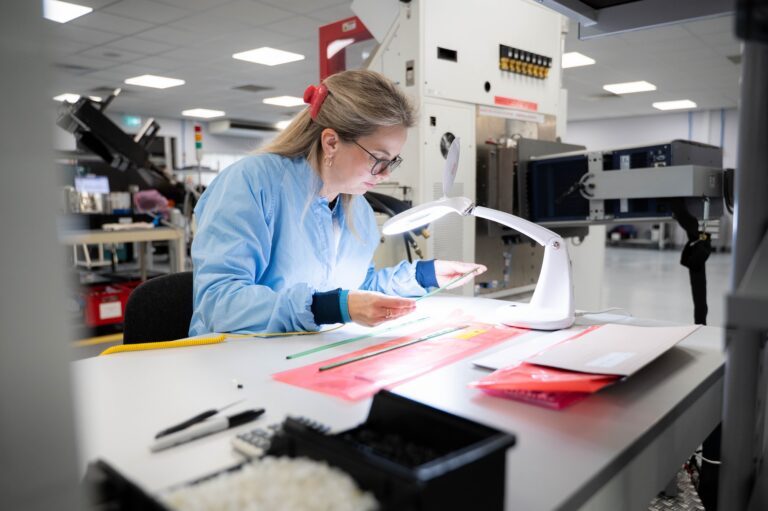
We managed the full development flow internally through our full turnkey (FTK) approach, covering ASIC design, physical layout, device evaluation, production, testing and development. Close collaboration with the manufacturer throughout formal design and release stages ensured the device aligned closely with the brake controller system architecture while remaining suitable for high-volume automotive production.
Because the ASIC was developed as a build-to-specification device, integration into existing brake controller platforms was comparatively straightforward. The manufacturer could implement the communication interface without extensive redesign work or additional external hardware, while maintaining tighter control over system-level electrical behaviour.
Following qualification, the ASIC entered production and was deployed across multiple HGV brake controller programmes. The device remained in service for many years, supporting communication between truck and trailer braking systems across demanding operating conditions.
Results: ASIC reliability in service
Reliability was naturally a major consideration throughout the programme. In braking applications, communication integrity between vehicle and trailer systems cannot become a point of instability or inconsistency. The ASIC therefore had to maintain predictable operation throughout extended service lifetimes while continuing to tolerate the electrical conditions typical of commercial vehicle platforms.
Over its production life, the device demonstrated stable field performance across multiple programmes, supporting the manufacturer’s braking systems without reported issues relating to the communication interface itself.
The project also highlighted why ASIC development continues to play an important role in tiered automotive electronics. While standard ICs may reduce development time in some applications, they are not always capable of meeting specialised electrical, integration or lifecycle demands simultaneously.
“In this case, the ASIC allowed the manufacturer to retain greater control over communication performance, system integration and product availability than would have been possible using available off-the-shelf alternatives,” said Ross Turnbull.
Conclusion

Explore custom IC solutions for your application
Discuss your project with our expert team. We deliver proven ASIC design, test, and supply with 40+ years of assured delivery.