From Plessey Semiconductors to an established UK ASIC company
Swindon Silicon Systems is one of the UK’s leading mixed-signal IC companies, and among a small number of British semiconductor businesses to have maintained continuous design and supply operations for over four decades. Specialising in application-specific integrated circuits (ASICs) for automotive, industrial, aerospace, and defence markets, Swindon Silicon occupies a distinctive position within the European semiconductor supply chain as a full turnkey fabless operation, handling IC design, test, and supply under one roof, from initial specification through to volume delivery.
In 1978, a team of engineers at Plessey Semiconductors founded Swindon Silicon Systems, today one of the UK’s leading mixed-signal IC companies, and among a small number of British semiconductor businesses to have maintained continuous design and supply operations for over four decades.
Given the pace of semiconductor technology advances the company has gone through a number of iterations.
What makes Swindon Silicon stand out is its adherence to producing application specific ICs (ASICS), a product technology which took a battering with the rise of the field programmable device.
Richard Mount (pictured), Director of Sales and Marketing at SSS makes a persuasive case for the ASIC.He takes the automotive market as an example.
“We sit down and talk to customers and you can soon discover they all have individual needs.
“We make a tyre pressure sensor and the fact is that tyres are different from car to car. They all have different requirements.”
“They make a technical case to us,” Mount continues. “They are clear about what they want from the performance of the chip. And we have to be sure we meet their demands.”

“Producing ASICs is not a necessarily a fast process. It can take nine months to produce samples and it can be up to two years to full production with a device that meets all the automotive industry standards.”
“It’s a big investment by us and the customer,” Mount asserts. “It is a partnership.”
Testimony to Swindon Silicon’s expertise is that it holds a market-leading position in tyre pressure monitoring systems (TPMS) globally and it can boast a blue-chip parade of its automotive customers including Jaguar, BMW, Mercedes-Benz, Volvo and Land Rover alongside Peugeot, Citroen and Volkswagen.
The company started business in an office above a dentist, and then to an old schoolhouse via a scout hut, something of a contrast to the modern facility it now occupies on the fringes of Royal Wootton Bassett in Wiltshire.
No disrespect to dentists but it is a better environment for the team of top division design and test engineers housed in the facility. The engineering team boasts 50+ engineers including 5 PhDs. And these people brim over with experience – their average directly related work experience totals a tidy 15 years.
What they bring perhaps more than any other attribute is the ability to integrate a host of semiconductor functions within a single IC.
Why ASICs, and why now
One question is why ASICs? Richard Mount jumps right in.
“The customer has to ask is an ASIC required?” he explains. “If yes, the benefits are multiple.”
“With our skills we can deliver a product that reduces size, power consumption, weight and most pertinently the cost.”
“And,” adds Mount, “an ASIC provides protection against obsolescence and protects IP.”
The Swindon Silicon team form a close-knit relationship with potential customers from day one. For a more detailed look at the business case around why to use an ASIC, visit our guide.
The ASIC design and development process
“The process starts at specification,” says Mount. “Does an ASIC make business sense, is there going to be a return on the investment?”
This initial engagement is designed to flesh out the answers to what the customer wants and what they are trying to achieve. From these first conversations Swindon Silicon develops a product specification and a cost analysis.
Once everybody’s happy to proceed, the Swindon Silicon design team works hand on hand with the customer.
“There’s constant communication through the design process,” says Mount. “Weekly conference calls, and at minimum a monthly face to face sit down.”
There’s little doubt that changes will be made to the initial specification as the design process continues.
“We can handle that,” Mount explains. “In fact we can make changes all the way up to the tape out.”
Prototyping, test and production
Swindon Silicon provides a full prototype / engineering sample service by either using MLM (Multi-Layer Mask) or MPW (Multi Project Wafer) engineering wafers. It will provide tested devices at this phase in order to enable the customer to evaluate the device in their system.
Samples are delivered and there can be a conversation about what’s right and what’s wrong.
“The device could be 100 per cent functional but need a tweak,” explains Mount.
Up to 2k devices can be delivered if required. Wafers are held in line at the foundry, usually at metal, during this phase in order to provide flexibility and speed if a design modification is provided and eliminates the requirement of starting new silicon.
Mostly the company uses multi-layer masks which says Mount “are more flexible.”
Says Mount, “We have reduced the test time of Devices Under Test (DUT) but also increased test coverage. This in turn minimises the final device cost but maximises performance through quality. The result is a dramatic increase in product repeatability, yield and overall test quality with a vast decrease in field failure ppm rates.”
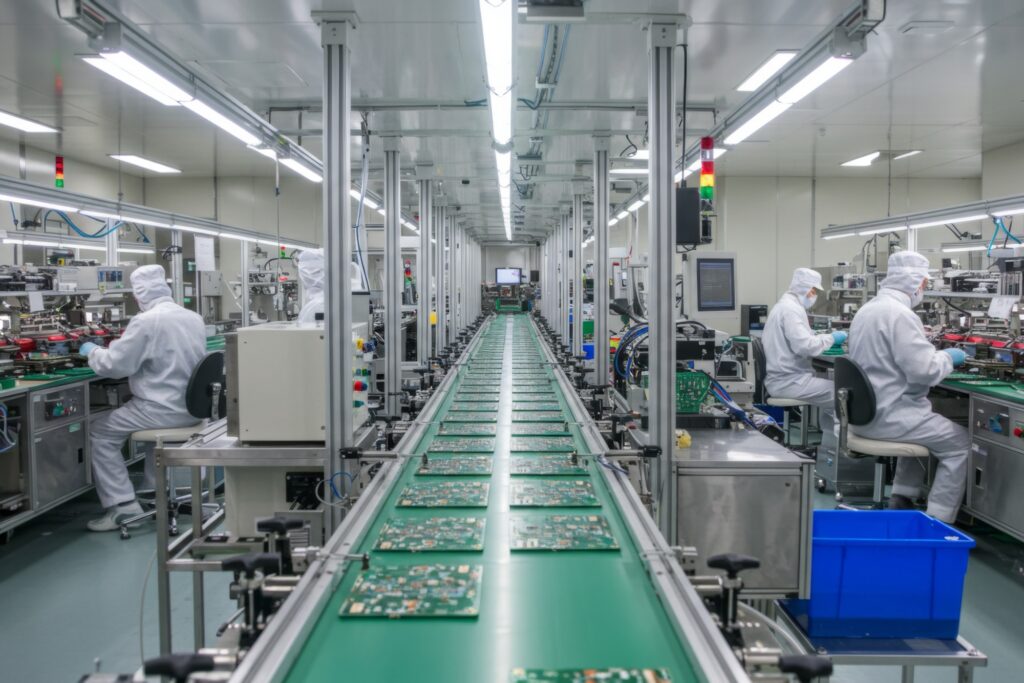
Underpinning that design capability is one of the UK’s most comprehensive IC test operations. At the time of writing, Swindon Silicon’s test facility housed 50 testers, 40 handlers including six MEMs handlers, and seven wafer probers capable of handling six-inch and eight-inch wafers in a class six clean room. Since then, the operation has grown significantly — today, production test is carried out across facilities in both the UK and Malaysia, with medium to high volume test capability across both sites.
The team first optimise the design for test (DfT) and manufacturability (DfM) as well as executing the various qualification tests, such as AEC Q100. Optimisation of the wafer probe and ATE test programs are also carried out to ensure high yields and low level ppm figures.
The company undertakes fully automated wafer and package level test, fully automated, online test and QA procedures, 100% wafer level test, 100% package level test. It provides real-time yield statistics, wafer and package level tests correlated, 100% Data log, tri temperature test and burn in.
Swindon Silicon is a fabless company. It partners with companies that offer both wafer packaging and foundry processing.
To meet customer requirements it works with three chip packaging partners covering a variety of options including leadless packages, MEMs packaging and custom packaging.
Chip manufacturing partners again offer an array of manufacturing processes and include global foundry market leader TSMC, alongside ams in Graz, xFAB and TowerJazz.
That breadth of application extends beyond automotive. Swindon Silicon Systems has collaborated with a battery management technology specialist to support the development of a mixed-signal IC-based battery management solution for electric vehicle, industrial, and grid energy storage applications. The solution acquires, processes, and stores data directly at the cell level, using wireless technology to transmit real-time information on cell health and performance to support master-level control of the battery pack.
To see how Swindon Silicon has applied this across a range of applications, explore our ASIC Design Examples.
Supply assurance and obsolescence protection
One other point Mount emphasises is the company’s obsolescence assurance.
“We don’t do obsolescence,” he says.
Security of supply is maintained keeping a store of wafer which can be used as and when needed.
If the manufacturing process is deemed obsolete, then Swindon Silicon will buy wafers to stock until a new design is developed onto a new manufacturing process.
Underlining the point, Mount says, “We still have 30 year old chips out there.”
Part of Sensata Technologies
In 2015, Swindon Silicon Systems became part of the now $6.4bn Sensata Technologies group, a global industrial technology company organised around three business segments: Automotive, Industrials, and Aerospace, Defence and Commercial Equipment. Automotive represents more than half of Sensata’s business, with the industrial and heavy vehicles and off-road (HVOR) markets forming a significant further share.
At the time of the acquisition, Mount explained, “The acquisition gives us more clout,” agrees Mount, “it has the potential to open up new markets for us and enables us to do what we are good at focus on supplying top quality solutions for our customers.”
That long-term stability is backed by Swindon Silicon’s position within the Sensata group, providing the financial and operational foundation to support long-lifecycle programmes and assured supply for customers with demanding, multi-decade product roadmaps.
As one of the UK’s longest-established fabless semiconductor companies, Swindon Silicon occupies a distinctive position in the European supply chain. Where many IC design functions have migrated to the US or Asia, Swindon has maintained its design, test, and supply operations in the UK for over 45 years, giving customers in automotive, industrial, and aerospace markets a reliable, proximate source of mixed-signal IC expertise.
The UK semiconductor industry itself remains a significant part of the global landscape, contributing billions to the national economy and spanning design, materials, and equipment. Swindon Silicon Systems has been part of that story since 1978 and continues to be.
If you’re exploring whether an ASIC is the right solution for your application, get in touch with the Swindon Silicon team to discuss your requirements.